Home > News > Industry News
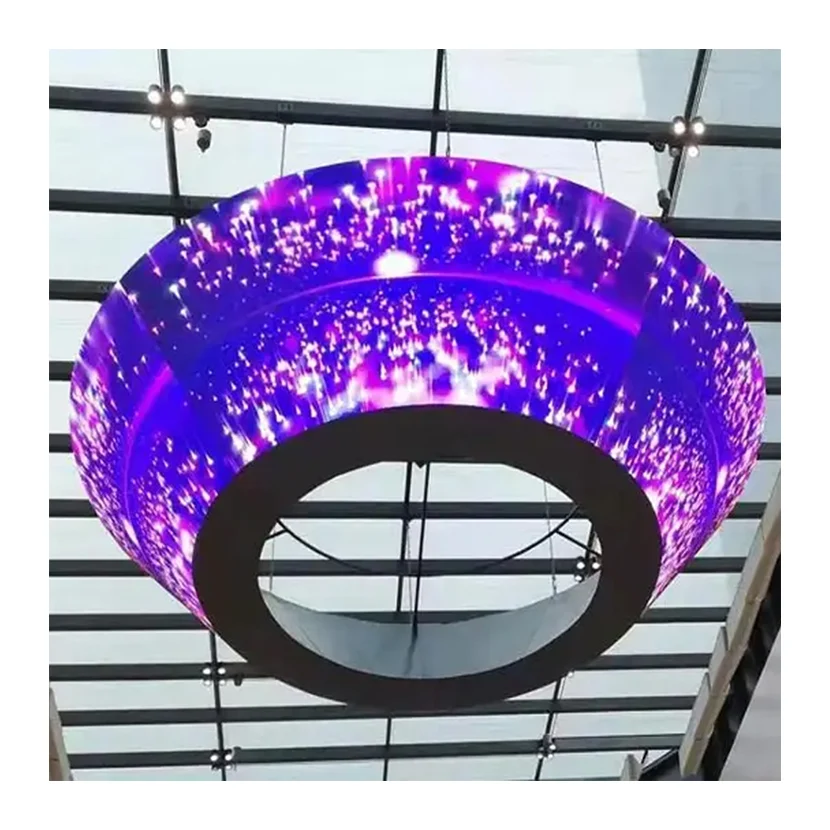
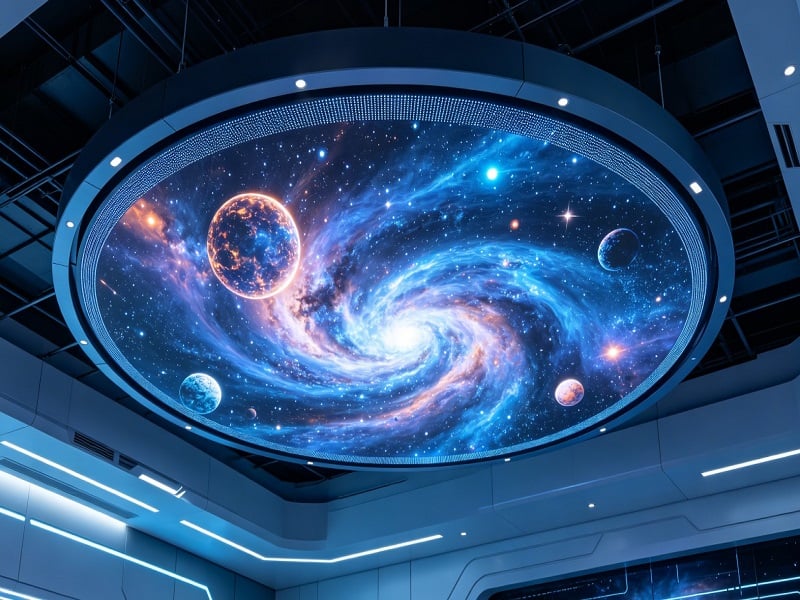
Museums no longer just showcase history; they curate unforgettable, multi-sensory journeys. When you introduce a custom 10-meter circular LED display into a grand exhibition hall, you open a portal to the cosmos. By leveraging the screen’s natural geometric symmetry, museum designers can craft the ultimate centerpiece: an interactive, gravity-defying black hole installation.
Here is how cutting-edge LED technology, real-time interactivity, and cosmic elements merge to create a show-stopping museum masterpiece.
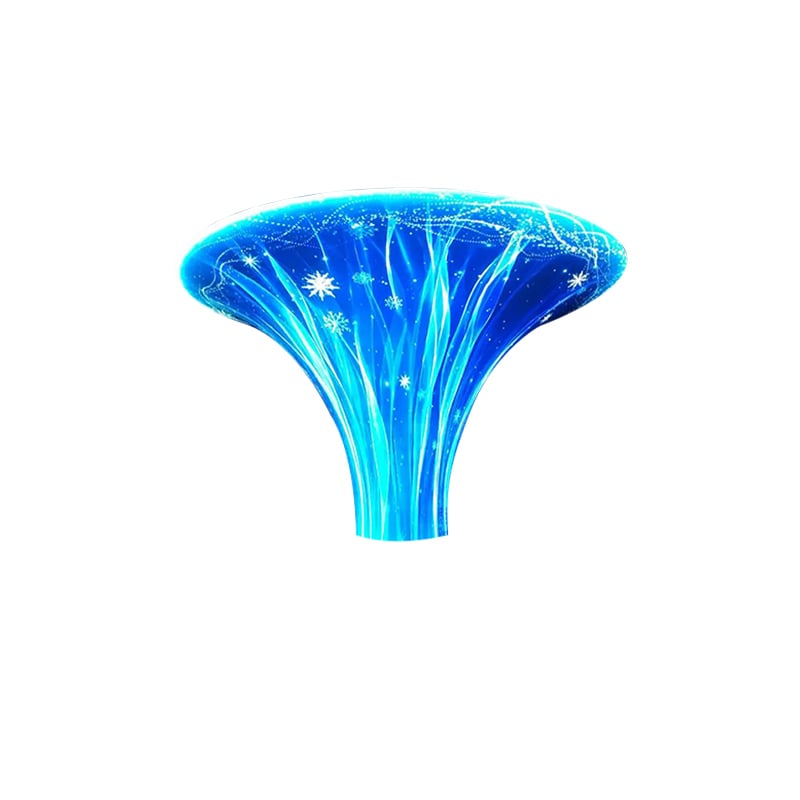
First and foremost, the circular silhouette of a 10-meter LED screen serves as the perfect canvas for a celestial vortex. At the heart of the display, ultra-high contrast LED modules produce an absolute, light-devouring pitch black, perfectly simulating a black hole's event horizon.
Surrounding this deep void, a hyper-realistic accretion disk flashes to life. Swirling gases and brilliant cosmic dust—rendered in vibrant shades of incandescent orange and electric blue—rotate gracefully during quiet moments. However, the true magic happens during the "consumption phase." Suddenly, the surrounding galaxy distorts via simulated gravitational lensing, pulling entire star systems into long, blinding streaks of light that plunge directly into the center.
Beyond mere observation, this installation actively involves the audience through state-of-the-art LiDAR sensor technology. By installing radar sensors along the gallery floor and display perimeter, the system maps the physical movements of the crowd.
Consequently, the exhibit transforms visitors into active participants in cosmic physics. As a guest approaches the screen, the system captures their silhouette and instantly digitizes them into a stream of shimmering "stellar fragments." If a visitor stands still, they create a subtle gravitational ripple in the flowing galaxy. If they run or gather in a group, they amplify the gravitational pull. As a result, the digital stardust accelerates, swirling violently before the black hole swallows it whole. This direct feedback loop ensures that no two visits to the exhibit are ever the same.
To solidify the illusion of space-time distortion, the visual narrative relies heavily on a specialized, reactive soundscape. Space may be a vacuum, but the exhibition hall resonates with an deep, multi-dimensional audio experience.
Engineers synchronize the LED visuals with infra-subwoofer arrays that emit a low-frequency "cosmic hum," mimicking actual gravitational waves. When the black hole reaches its peak consumption threshold, the entire hall triggers a dramatic shift. The gallery lights instantly plunge into darkness, the subwoofers emit a powerful, bone-rattling rumble, and a wave of pure audio-visual pressure washes over the audience.
Ultimately, this seamless blend of massive circular LED engineering, real-time motion tracking, and spatial audio creates more than just an exhibit—it delivers an unforgettable emotional encounter with the universe.
A circular LED display naturally matches the physical geometry of celestial bodies and gravitational vortices. By eliminating sharp corners, the 10-meter round screen provides an organic, boundary-free viewport that enhances the optical illusion of a spinning accretion disk and a central void, maximizing viewer immersion.
To achieve a truly convincing black hole, the display requires an exceptionally high contrast ratio and superior black-level performance. Utilizing premium "black-body" LEDs ensures that the center of the black hole remains completely dark without any grey light leakage. Additionally, a high refresh rate and fine pixel pitch are crucial for rendering smooth, fluid movements of cosmic dust particles without trailing or pixelation.
The LiDAR (Light Detection and Ranging) system scans the exhibition zone in real-time, tracking multiple moving targets simultaneously. The interactive software calculates the density, speed, and proximity of the crowd, translating their collective movements into localized "gravitational forces" on the screen. This allows dozens of visitors to interact with the cosmic elements concurrently without system lag.
 EN
EN
 AR
AR
 BG
BG
 HR
HR
 CS
CS
 DA
DA
 NL
NL
 FI
FI
 FR
FR
 DE
DE
 EL
EL
 HI
HI
 IT
IT
 JA
JA
 KO
KO
 NO
NO
 PL
PL
 PT
PT
 RO
RO
 RU
RU
 ES
ES
 SV
SV
 TL
TL
 ID
ID
 SR
SR
 UK
UK
 VI
VI
 ET
ET
 HU
HU
 TH
TH
 TR
TR
 FA
FA
 AF
AF
 MS
MS
 GA
GA
 HY
HY
 AZ
AZ
 MN
MN
 UZ
UZ