Home > News > Industry News
A wine bottle shaped LED display belongs to the category of creative 3D LED screens. Unlike conventional flat LED displays, this type of screen combines irregular structures, flexible LED modules, seamless curved assembly, and intelligent control systems to recreate the appearance of a real bottle with high precision.
Manufacturers mainly focus on three core areas when developing a bottle-shaped LED display:
Below are the most important technical points behind a wine bottle LED screen.
The biggest advantage of a bottle-shaped LED display lies in its ability to replicate a real bottle almost perfectly. Therefore, structural engineering plays a critical role throughout the project.
Manufacturers usually build the internal framework with hollow aluminum materials. This design improves structural strength while reducing overall weight. At the same time, the aluminum structure helps dissipate heat more efficiently.
As a result, the display becomes easier to install, safer to transport, and more stable during long-term operation.
Since every bottle has different dimensions and curves, engineers must customize the PCB layout according to:
Instead of using standard rectangular layouts, designers create non-standard flexible PCB structures that follow the exact contour of the bottle surface.
Modern manufacturing techniques allow the screen to reproduce bottle details with extremely high accuracy. Manufacturers can customize:
This approach achieves more than 99% visual restoration accuracy and supports various shapes, including:
Traditional rigid LED cabinets cannot handle complex curved surfaces, especially around the bottle shoulder and bottom. Therefore, manufacturers rely heavily on flexible LED modules.
Instead of conventional fiberglass PCBs, flexible LED modules use FPC (Flexible Printed Circuit) boards.
These materials offer several advantages:
As a result, the LED modules can wrap smoothly around cylindrical and tapered structures.
Manufacturers also use silicone or rubber materials for the front masks and bottom shells.
These materials provide:
More importantly, silicone materials help maintain module stability even after repeated bending.
To simplify installation and maintenance, engineers equip the modules with strong magnetic cores.
Installers can directly attach the modules to the custom steel or aluminum framework without complicated fixing procedures. This magnetic design significantly reduces installation time and improves serviceability.
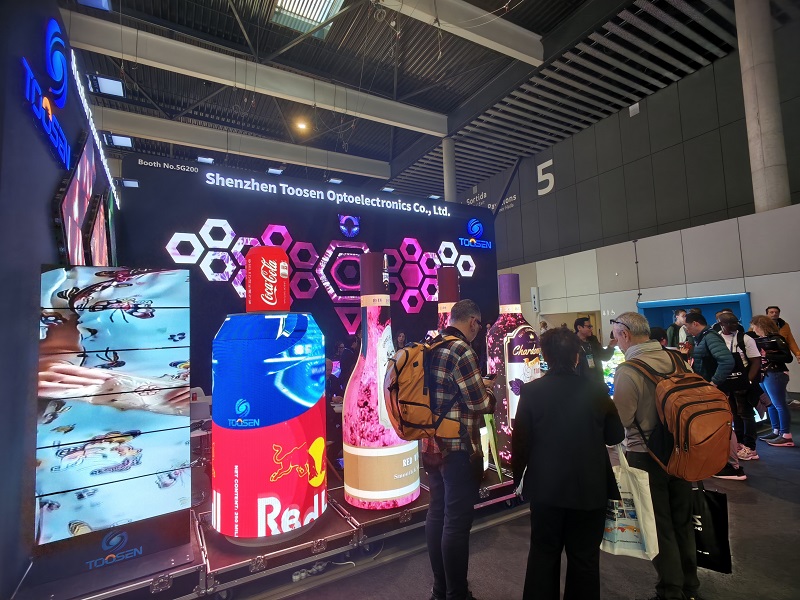
Curved LED splicing remains one of the most difficult technical challenges in bottle-shaped displays.
If manufacturers fail to control the surface precisely, the display may suffer from:
To avoid these problems, manufacturers apply several advanced techniques.
Engineers combine fan-shaped, curved, and other non-standard modules to reduce visible gaps between panels.
This method creates a smoother and more continuous bottle surface.
Manufacturers use custom PCB alignment systems and precision locking structures to keep adjacent modules tightly connected.
As a result, the seams remain nearly invisible even at close viewing distances.
The control system also plays an essential role.
Advanced calibration software continuously adjusts image continuity across irregular curved surfaces. Consequently, the display maintains consistent visuals even when the content wraps around the bottle.
Outdoor bottle-shaped LED screens face additional environmental challenges. Therefore, manufacturers must improve waterproofing, weather resistance, and structural durability.
Outdoor flexible modules typically use double-sided glue filling technology to seal the internal components.
This process prevents:
As a result, the screen achieves stable long-term outdoor performance.
Outdoor silicone materials must withstand:
Otherwise, the protective surface may discolor, harden, or crack over time.
Although flexible modules improve shape adaptability, the display still needs strong impact resistance and wear resistance comparable to traditional rigid LED screens.
Therefore, manufacturers must carefully balance flexibility and structural strength.
The display structure alone cannot create an immersive experience. Content adaptation and intelligent control systems are equally important.
Most bottle-shaped LED screens use cylindrical or semi-cylindrical structures. Therefore, the control system must support seamless 360-degree content playback.
Viewers should see complete and coherent visuals from any angle.
Manufacturers often combine the display with 3D modeling technology.
This allows brands to present:
The curved surface enhances depth perception and creates a more immersive visual experience.
Advanced distributed scanning systems enable point-by-point LED control across curved surfaces.
This technology improves:
Even on rotating or irregular structures, the display maintains stable visual quality.
The core technology behind a wine bottle shaped LED display can be summarized in one sentence:
“Flexible modules solve the shape challenge, custom structures solve the precision challenge, and intelligent control systems solve the display challenge.”
Compared with traditional flat LED screens, bottle-shaped LED displays require:
However, they also deliver a far stronger visual impact. For retail stores, liquor brands, exhibitions, and immersive marketing environments, these creative LED installations offer a unique combination of technology, branding, and artistic presentation.
 EN
EN
 AR
AR
 BG
BG
 HR
HR
 CS
CS
 DA
DA
 NL
NL
 FI
FI
 FR
FR
 DE
DE
 EL
EL
 HI
HI
 IT
IT
 JA
JA
 KO
KO
 NO
NO
 PL
PL
 PT
PT
 RO
RO
 RU
RU
 ES
ES
 SV
SV
 TL
TL
 ID
ID
 SR
SR
 UK
UK
 VI
VI
 ET
ET
 HU
HU
 TH
TH
 TR
TR
 FA
FA
 AF
AF
 MS
MS
 GA
GA
 HY
HY
 AZ
AZ
 MN
MN
 UZ
UZ