Home > News > Company News
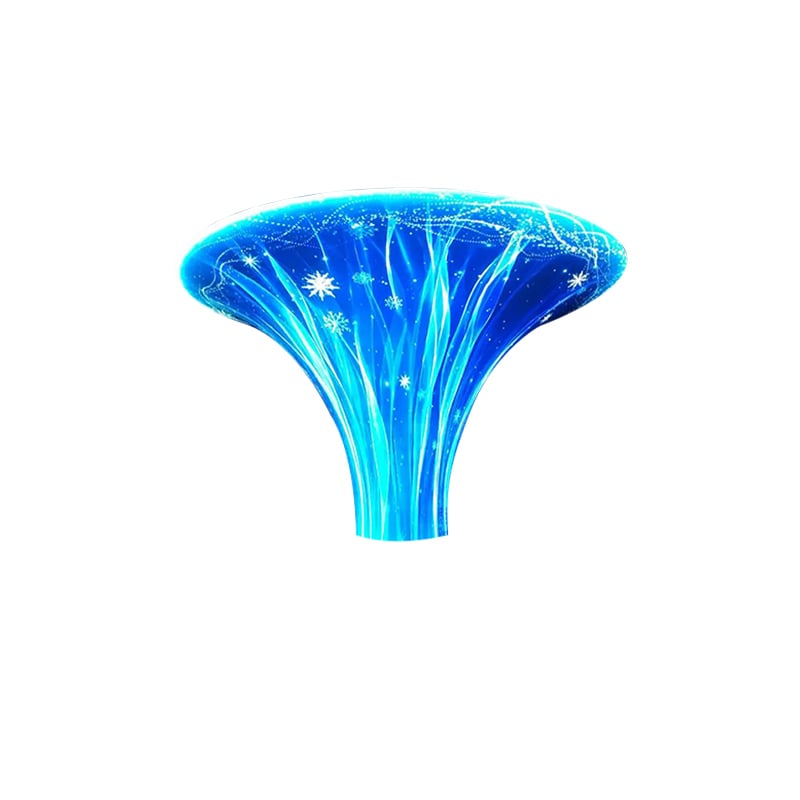
An outdoor Christmas tree LED display creates a stunning visual landmark during holidays and events. However, its unique shape also introduces challenges that standard LED screens rarely face. Moisture accumulation, uneven heat distribution, and difficult maintenance access can all shorten the display's lifespan if designers fail to address them early.
To ensure long-term reliability, manufacturers should prioritize both anti-corrosion protection and efficient thermal management during the design stage.
Unlike traditional flat LED screens, a Christmas tree-shaped LED display features multiple branches, varying angles, and complex structural joints. These design elements create hidden areas where water, dust, and heat can accumulate.
As a result, outdoor Christmas tree LED screens often experience:
Proper engineering can prevent these issues and significantly extend the service life of the display.
Material selection forms the foundation of any outdoor LED project.
The following components offer better protection in harsh environments:
| Component | Recommended Material | Avoid |
|---|---|---|
| Cabinet Structure | Die-cast aluminum (ADC12) with protective coating | Untreated steel or standard sheet metal |
| Fasteners | 316 stainless steel screws | 304 stainless steel in coastal areas |
| PCB Boards | ENIG (Electroless Nickel Immersion Gold) with conformal coating | Standard HASL boards |
| Power Supplies & Cables | Outdoor waterproof power supplies and silicone cables | Indoor PVC wiring |
High-quality materials reduce oxidation, improve weather resistance, and lower maintenance costs over time.
One of the biggest challenges of Christmas tree-shaped LED displays is water retention.
The branches and decorative layers often create pockets where rainwater collects. Over time, standing water can damage electronics and accelerate corrosion.
To minimize this risk:
These measures help rainwater drain quickly instead of remaining trapped inside the structure.
Many Christmas tree LED displays support additional decorations such as:
These accessories place extra stress on attachment points.
Therefore, designers should:
This approach helps maintain structural integrity throughout multiple holiday seasons.
Because Christmas tree LED screens use non-standard shapes, traditional sealing methods may leave gaps between modules.
Manufacturers should use:
Effective sealing prevents moisture, dust, and insects from entering sensitive electronic areas.
For long-term outdoor durability, a complete coating system provides better protection than a single paint layer.
A common industrial solution includes:
Epoxy zinc-rich primer provides cathodic protection and reduces rust formation.
Epoxy micaceous iron oxide coating improves adhesion and enhances barrier protection.
Fluorocarbon paint delivers excellent UV resistance and weather protection for more than 15 years.
In coastal or high-salt environments, engineers often add sacrificial zinc anodes to further protect steel structures from corrosion.
Heat management becomes more difficult because of the tree's shape.
| Challenge | Cause | Impact |
|---|---|---|
| Heat accumulation at the top | Restricted airflow near the tree crown | Upper modules may run 15–20°C hotter |
| Irregular airflow paths | Non-standard branch angles | Traditional cooling designs become less effective |
| Decorative blockage | Ornaments cover ventilation areas | Cooling efficiency drops significantly |
Without proper thermal management, excessive temperatures can reduce brightness, shorten LED lifespan, and increase failure rates.
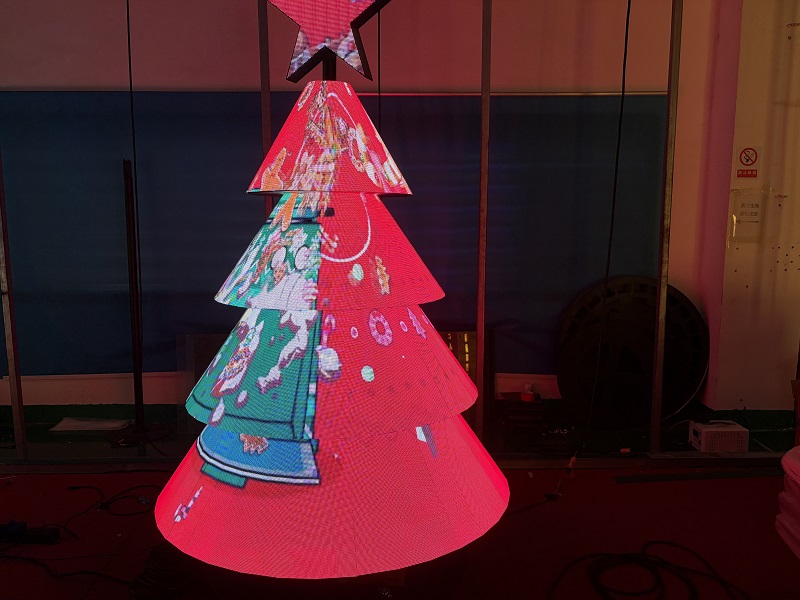
For displays taller than 5 meters, active cooling often delivers the best performance.
Design a hollow central trunk that acts as a vertical airflow channel.
The system works by:
This chimney effect improves airflow without requiring excessive power consumption.
Strategically place waterproof micro-fans behind the LED modules.
Benefits include:
For outdoor applications, IP68-rated fans provide reliable protection against moisture and dust.
The tree crown often experiences the highest temperatures.
Heat pipes can transfer heat from upper sections to larger cooling surfaces located inside the trunk or near the base.
This method:
Smaller decorative Christmas tree LED screens may not require active cooling systems.
Instead, designers can improve heat dissipation through material selection and structural design.
Aluminum-based circuit boards conduct heat much more efficiently than traditional fiberglass PCBs.
Advantages include:
Non-display areas can incorporate:
These features increase airflow while maintaining protection against rain and dust.
Modern high-luminous-efficiency LEDs generate less heat while maintaining brightness.
Choosing LEDs with efficacy above 150 lm/W can significantly reduce thermal load from the source.
Even the best cooling system benefits from real-time monitoring.
Install temperature sensors in critical locations:
This setup provides a complete thermal profile of the display.
When temperatures exceed preset thresholds, the control system can automatically reduce brightness.
For example:
This feature protects both the LEDs and power supplies.
Cold climates introduce another challenge: condensation.
To prevent moisture from forming inside the cabinets, designers can install PTC heating elements that maintain the internal temperature above the dew point when the screen is idle.
This simple solution helps prevent corrosion and electrical failures during winter operation.
Many Christmas tree LED projects fail to consider long-term maintenance.
Because of the complex shape, repairs can become difficult and expensive after installation.
For large displays, a hollow trunk with a diameter of at least 60 cm allows technicians to access internal components safely.
Magnetic or tool-free locking systems enable technicians to replace LED modules from the front without dismantling large sections of the structure.
Place power supplies, controllers, cooling equipment, and communication devices inside a maintenance compartment at the base of the tree.
This arrangement minimizes high-altitude maintenance work and reduces service time.
A successful outdoor Christmas tree LED display requires more than creative design. Long-term performance depends on robust anti-corrosion protection, efficient heat dissipation, and practical maintenance planning.
By selecting corrosion-resistant materials, improving drainage, optimizing airflow, implementing intelligent temperature monitoring, and designing accessible maintenance systems, operators can significantly increase the reliability and lifespan of their Christmas tree LED installations while reducing operating costs year after year.
 EN
EN
 AR
AR
 BG
BG
 HR
HR
 CS
CS
 DA
DA
 NL
NL
 FI
FI
 FR
FR
 DE
DE
 EL
EL
 HI
HI
 IT
IT
 JA
JA
 KO
KO
 NO
NO
 PL
PL
 PT
PT
 RO
RO
 RU
RU
 ES
ES
 SV
SV
 TL
TL
 ID
ID
 SR
SR
 UK
UK
 VI
VI
 ET
ET
 HU
HU
 TH
TH
 TR
TR
 FA
FA
 AF
AF
 MS
MS
 GA
GA
 HY
HY
 AZ
AZ
 MN
MN
 UZ
UZ