Home > News > Company News
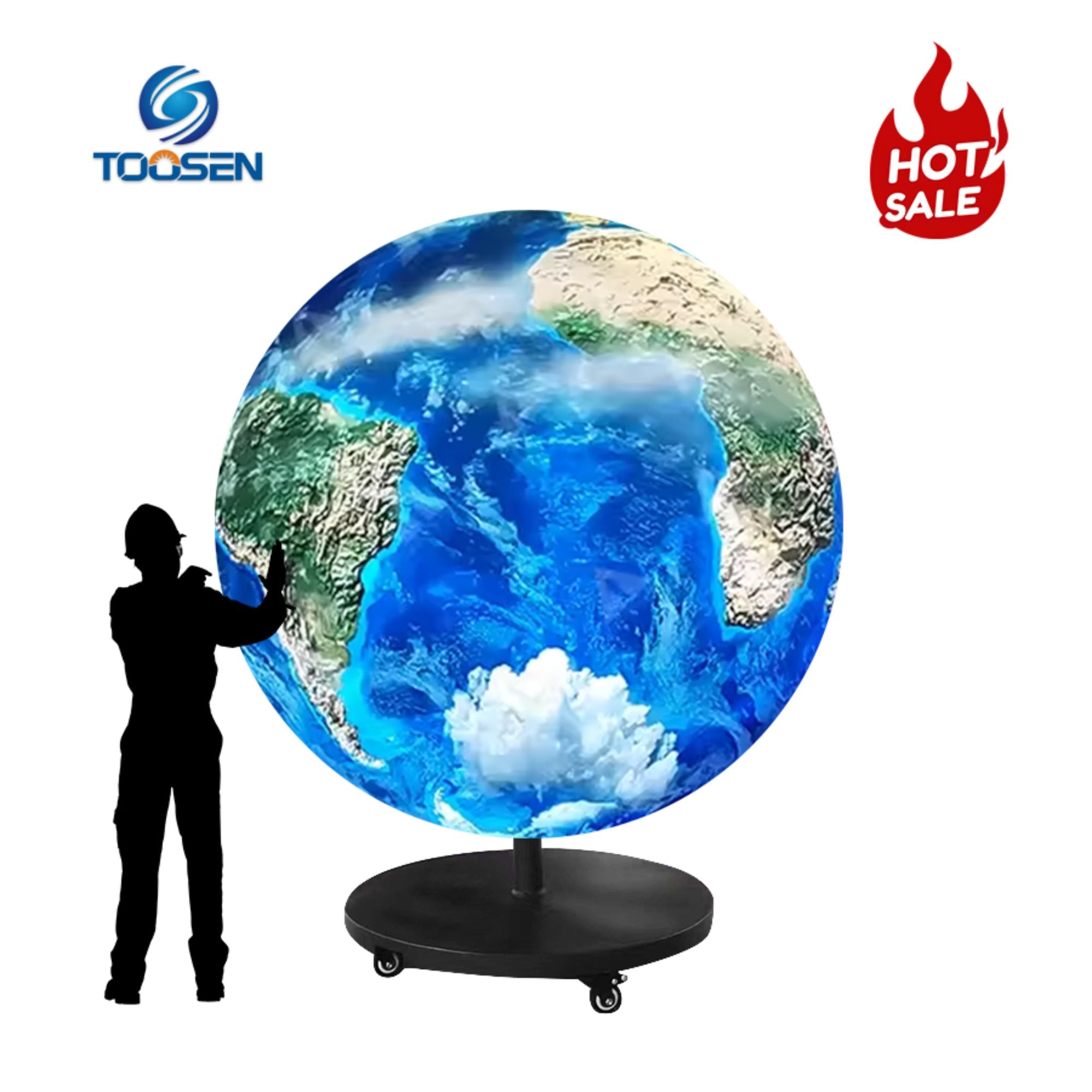
Spherical LED displays have changed the way people experience digital signage. Unlike conventional flat LED screens, they provide a true 360-degree viewing experience and attract attention from every direction. Today, you can find spherical LED displays in shopping malls, museums, science centers, airports, theme parks, and public landmarks around the world.
The most well-known example is the Las Vegas Sphere. Standing 112 meters tall with a diameter of 157 meters, it is currently the world's largest spherical LED display. Every night, its exterior transforms into realistic images ranging from a giant eyeball to a rotating Earth and animated visual effects.
While most people focus on the display itself, few consider the engineering behind it. A spherical LED display is far more complex than bending a flat LED screen into a circle. It requires a specialized internal structure that supports curved LED modules, distributes weight evenly, manages heat efficiently, synchronizes millions of pixels, and withstands environmental forces.
This article explains how a spherical LED display is built by examining the major structural components behind this technology.
Before discussing the internal structure, it helps to understand why the Las Vegas Sphere has become an industry benchmark.
Completed in 2023, the Sphere features approximately 1.2 million hockey puck-sized LED nodes across an exterior display area of roughly 54,000 square meters. Inside the building, a second LED display covers the interior dome above more than 17,000 seats, creating one of the world's largest immersive viewing environments.
Although the exterior and interior displays serve different purposes, they operate through an integrated control system while functioning independently. This dual-display architecture demonstrates many of the engineering principles used in modern spherical LED displays.
The structural frame forms the backbone of every spherical LED display.
Unlike flat LED screens that use rectangular cabinets, spherical displays require a three-dimensional space frame that follows the shape of the sphere.
Manufacturers typically build this framework from high-strength aluminum alloy or galvanized steel. The frame consists of multiple triangular or hexagonal sections that approximate a spherical surface while maintaining high structural strength.
Each connection point includes an adjustable joint. During installation, technicians adjust these joints to achieve a smooth and accurate sphere.
Smaller indoor spheres with diameters between one and three meters often use integrated die-cast aluminum frames instead of large space truss systems.
For large outdoor displays, engineers also calculate the center of gravity carefully. Heavy concrete foundations and internal counterweights help maintain long-term stability against wind loads.
One advantage of modular structural frames is simplified maintenance. Each structural section supports its own LED modules, allowing technicians to replace individual components without disassembling the entire display.
LED modules create the visible surface of the sphere.
Unlike conventional rectangular LED panels, spherical displays require specially designed modules that fit curved surfaces.
Manufacturers generally choose between two solutions.
Flexible modules use flexible PCB materials and silicone backing.
Because they bend easily, they work well for small spherical displays with tight curvature.
Typical applications include:
Large outdoor spheres usually use rigid trapezoidal or triangular LED modules.
Each module has precisely machined edges that fit together like a polygonal shell. This design approximates a smooth sphere while maintaining structural rigidity.
A sphere presents another engineering challenge.
The circumference becomes smaller toward the poles, while the equator remains the largest section. As a result, equal pixel spacing would create visual distortion.
Manufacturers solve this problem by adjusting module layouts and applying image mapping algorithms. Some spherical displays also vary pixel density across different regions to maintain consistent image proportions from every viewing angle.
The packaging technology depends on the installation environment.
Outdoor spherical LED displays commonly use SMD or DIP LEDs because they provide high brightness and weather resistance.
Indoor immersive installations increasingly use COB technology, which delivers higher contrast, improved black levels, and greater durability.
Heat management becomes more challenging inside a spherical enclosure than inside a flat display.
Warm air naturally rises toward the top of the sphere, creating localized hot spots.
Manufacturers address this issue through several cooling strategies.
Engineers design circular or spiral airflow channels inside the structure.
These channels draw cool air from the lower section while directing warm air toward exhaust outlets near the top.
Large outdoor displays also include industrial cooling fans that create continuous forced airflow.
Instead of cooling the entire sphere uniformly, manufacturers divide the display into multiple thermal zones.
Each zone includes:
This design prevents localized overheating and helps maintain consistent brightness and color performance.
Many LED modules use aluminum substrates or thermally conductive coatings.
These materials transfer heat efficiently from the LEDs into the structural frame, which acts as a large heat sink.
For extremely large installations such as the Las Vegas Sphere, the cooling system must regulate both the LED electronics and the interior environment simultaneously.
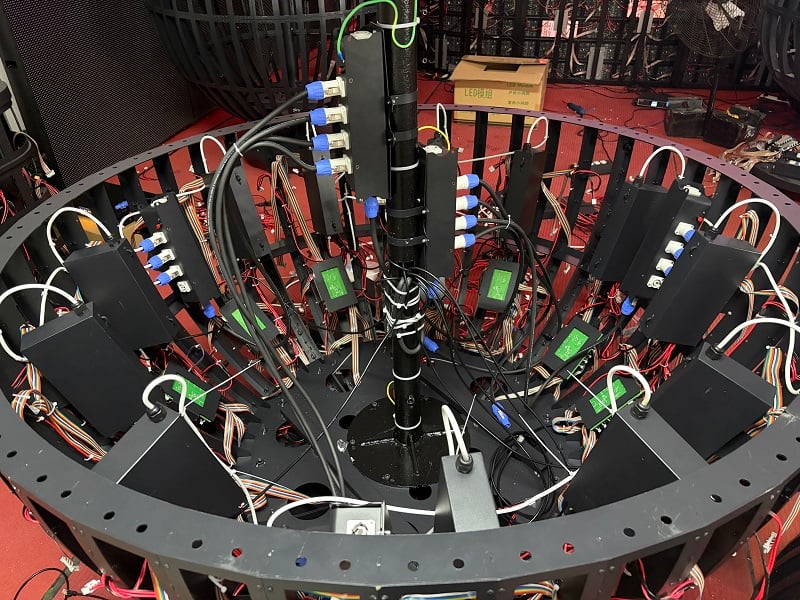
Displaying synchronized content across a spherical surface requires a specialized control architecture.
Unlike flat LED walls that use simple row-and-column layouts, spherical displays require signal routing that follows the geometry of the sphere.
Signal distribution typically begins at centralized control cabinets located near the base of the structure.
From there, optical fiber and network cables distribute data through latitude and longitude pathways to minimize signal delay.
Large spherical LED displays may use dozens or even hundreds of receiving cards.
Each receiving card controls one section of the sphere, while a central server synchronizes every controller to maintain frame accuracy across the entire display.
Every LED module requires factory calibration before installation.
Technicians adjust:
Because every pixel sits at a different viewing angle, software also compensates for geometric distortion to ensure that graphics appear correctly from multiple viewing positions.
The power system supplies stable electricity to every LED module.
Instead of using a single power source, manufacturers divide the sphere into multiple independent power zones.
Each zone contains its own:
This distributed architecture improves reliability and reduces the impact of localized failures.
Critical outdoor installations often include redundant power lines. If the primary circuit fails, the backup circuit automatically supplies power within milliseconds.
Outdoor spherical LED displays also require waterproof electrical connectors, surge protection, and lightning protection systems to ensure reliable operation in harsh environments.
Although they share the same engineering principles, large outdoor installations and smaller indoor displays differ significantly in scale.
| Component | Large Outdoor Spherical LED Display | Small Indoor Spherical LED Display |
|---|---|---|
| Structural Frame | Steel space truss with concrete foundation | Integrated die-cast aluminum frame |
| LED Modules | Custom rigid trapezoidal modules | Flexible or compact rigid modules |
| Cooling | Forced air cooling with industrial ventilation | Natural airflow or small cooling fans |
| Maintenance | Front access and maintenance platforms | Magnetic front maintenance |
| Control System | Multiple servers and receiving cards | Single controller with asynchronous playback |
Spherical LED display technology continues to evolve.
Manufacturers now focus on reducing weight, simplifying installation, and improving maintenance efficiency.
Several technologies are driving this development, including:
These innovations may reduce structural complexity while improving display performance and energy efficiency.
A spherical LED display combines structural engineering, electronics, thermal management, and digital imaging into a single integrated system.
Its internal structure includes a precision-engineered support frame, custom LED modules, advanced cooling solutions, distributed power systems, and synchronized control architecture. Every component contributes to the display's stability, image quality, and long-term reliability.
Whether you are looking at the Las Vegas Sphere or a two-meter display inside a shopping mall, both systems rely on the same engineering principles. The main differences lie in their scale, component capacity, and system complexity rather than their underlying design.
A spherical LED display typically consists of a structural frame, LED modules, power supplies, receiving cards, control systems, signal cables, and a cooling system. These components work together to support the spherical shape while delivering stable, synchronized 360-degree visual performance.
Manufacturers use either flexible LED modules or custom-shaped rigid modules, depending on the size of the sphere. Flexible modules suit smaller displays with tighter curves, while large spherical displays use trapezoidal or triangular modules that fit together to form a near-perfect sphere.
Most spherical LED displays use a combination of airflow channels, cooling fans, temperature sensors, and heat-conductive materials to manage heat. Large outdoor models often include forced-air cooling systems to maintain stable operating temperatures during continuous use.
 EN
EN
 AR
AR
 BG
BG
 HR
HR
 CS
CS
 DA
DA
 NL
NL
 FI
FI
 FR
FR
 DE
DE
 EL
EL
 HI
HI
 IT
IT
 JA
JA
 KO
KO
 NO
NO
 PL
PL
 PT
PT
 RO
RO
 RU
RU
 ES
ES
 SV
SV
 TL
TL
 ID
ID
 SR
SR
 UK
UK
 VI
VI
 ET
ET
 HU
HU
 TH
TH
 TR
TR
 FA
FA
 AF
AF
 MS
MS
 GA
GA
 HY
HY
 AZ
AZ
 MN
MN
 UZ
UZ