Home > News > Industry News
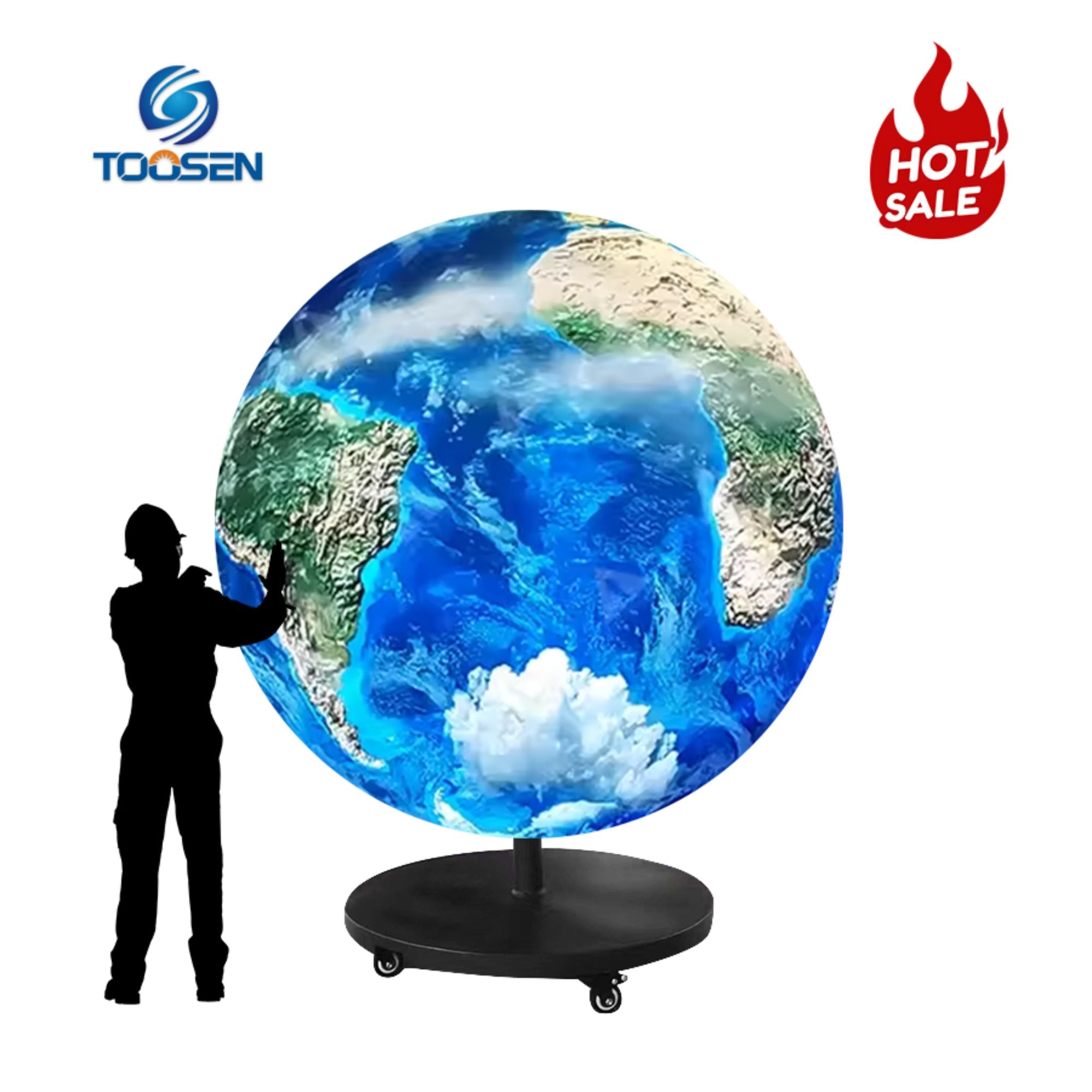
When people first see a rotating spherical LED display, they often assume that thousands of LED modules form a solid glowing ball. In reality, many of these displays use a completely different technology.
Instead of building a physical sphere from LED panels, a mechanical rotating spherical LED display relies on POV (Persistence of Vision) technology. By spinning LED strips at high speed and precisely controlling each LED, the system creates the illusion of a complete floating sphere in midair.
This approach dramatically reduces LED usage while still delivering an impressive 360-degree visual effect.
The operating principle is surprisingly simple.
Think about a household fan. When the blades spin slowly, you can clearly see each blade. However, once the fan reaches a high speed, the blades seem to disappear and form a continuous circular surface.
A rotating spherical LED display works in a similar way.
One or more LED strips are mounted on a rotating arm. These strips spin rapidly around a central axis, often at several hundred to several thousand revolutions per minute (RPM).
At the same time, the control system calculates:
Because the LEDs flash at precisely controlled moments, the human eye merges these individual light points into a complete spherical image.
As a result, viewers perceive a solid illuminated globe even though most of the space inside the sphere is actually empty.
A rotating spherical display combines electronic, mechanical, and software systems into a single device.
The rotating arm supports the LED strips and spins at high speed.
This component must maintain perfect balance throughout operation. Even a small imbalance can generate excessive vibration, noise, and mechanical stress.
The display surface consists of high-density LED strips mounted on the rotating structure.
Manufacturers typically use lightweight customized LED boards to minimize centrifugal force and reduce motor load.
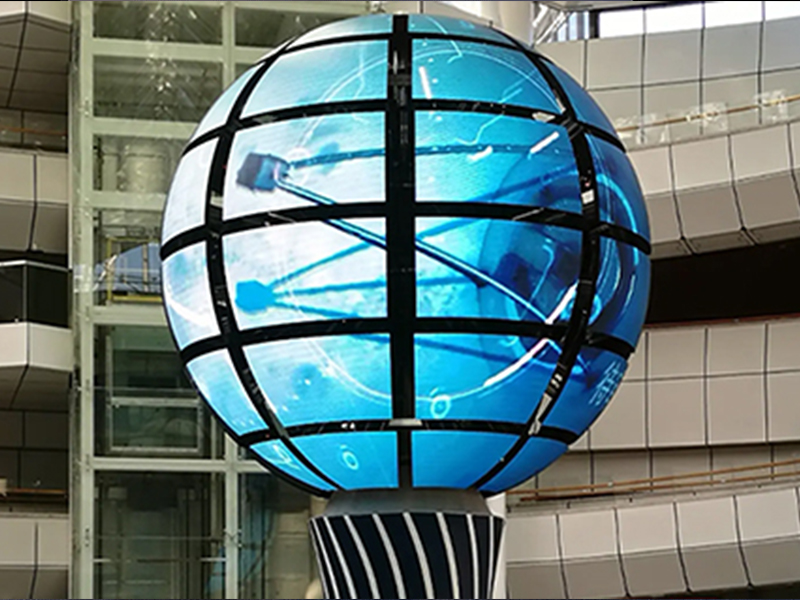
A slip ring transfers power and data from the stationary structure to the rotating assembly.
Without a slip ring, cables would twist and quickly become damaged.
Since slip rings contain physical contact points, they often become one of the primary maintenance items in rotating LED spheres.
The motor controls the rotation speed of the display.
Most manufacturers use high-performance brushless DC motors because they provide smooth operation, high efficiency, and precise speed control.
Even slight speed variations can affect image quality.
The controller serves as the brain of the display.
It continuously synchronizes:
To achieve this, the system usually works together with a high-precision rotary encoder that provides real-time position feedback.
Since the display contains rapidly rotating components, safety protection is essential.
Manufacturers often install:
The enclosure must protect viewers while allowing maximum light transmission.
Although both products create spherical visual effects, their structures and performance differ significantly.
| Feature | Mechanical Rotating Sphere | Solid Spherical LED Display |
|---|---|---|
| Structure | Rotating arms and LED strips | Custom triangular or trapezoidal LED modules |
| Internal Space | Hollow interior | Solid display surface |
| Cost | Lower | Much higher |
| LED Quantity | Relatively small | Very large |
| Resolution | Limited by rotation speed and LED density | Can achieve very high resolution |
| Viewing Experience | May show slight flicker at certain angles | True physical spherical surface |
| Reliability | Contains moving parts | No moving parts |
| Maintenance | Higher maintenance requirements | Lower maintenance requirements |
| Installation | Requires dynamic balancing | Static structure |
| Content Requirements | Specialized POV content | Standard spherical mapping content |
 EN
EN
 AR
AR
 BG
BG
 HR
HR
 CS
CS
 DA
DA
 NL
NL
 FI
FI
 FR
FR
 DE
DE
 EL
EL
 HI
HI
 IT
IT
 JA
JA
 KO
KO
 NO
NO
 PL
PL
 PT
PT
 RO
RO
 RU
RU
 ES
ES
 SV
SV
 TL
TL
 ID
ID
 SR
SR
 UK
UK
 VI
VI
 ET
ET
 HU
HU
 TH
TH
 TR
TR
 FA
FA
 AF
AF
 MS
MS
 GA
GA
 HY
HY
 AZ
AZ
 MN
MN
 UZ
UZ