Home > News > Industry News
When it comes to outdoor LED displays, durability and reliability always come first. While manufacturers continue to improve cabinet designs and materials, many people mistakenly assume that an all-aluminum LED display can completely solve heat dissipation issues.
In reality, even the best aluminum LED screens still require proper thermal management.
Without adequate cooling, excessive heat can reduce image quality, shorten component lifespan, and increase maintenance costs.
Today, many outdoor LED displays use aluminum modules and aluminum cabinets instead of traditional plastic modules and steel structures.
This shift offers several advantages.
Most importantly, aluminum conducts heat much more efficiently than plastic. As a result, heat can spread across the cabinet faster and escape more easily.
However, aluminum only helps transfer heat. It does not remove heat from the system.
If hot air becomes trapped inside the display structure, the temperature will continue to rise regardless of the cabinet material.
Therefore, operators should never assume that an all-aluminum LED display can operate safely without additional cooling considerations.
The way you install an outdoor LED screen directly affects its cooling performance.
For example, wall-mounted LED displays and three-sided column LED displays often have limited airflow behind the screen. Since fresh air cannot circulate freely, heat tends to accumulate inside the structure.
As a result, the internal temperature can rise rapidly, especially during summer months or in regions with strong sunlight.
According to feedback from some LED display operators, internal temperatures can reach approximately 80°C (176°F) under extreme conditions.
At these temperatures, the display faces several serious risks.
Excessive heat affects LED performance and visual consistency.
When temperatures rise too high, viewers may notice:
These issues can significantly weaken the impact of advertising content.
Temperature changes can alter RGB wavelength performance.
Consequently, the display may develop noticeable color shifts, particularly yellowish or reddish tones. These changes reduce image fidelity and make advertisements appear less professional.
Heat accelerates component aging throughout the display system.
Critical components affected by overheating include:
As temperatures increase, these components experience greater stress, which can lead to premature failure.
Frequent overheating often results in more repairs and replacement parts.
Over time, maintenance expenses increase while overall system reliability decreases. For billboard operators managing multiple installations, these costs can quickly add up.
Poor image quality and unexpected downtime directly affect advertising performance.
If a display cannot consistently deliver bright and attractive content, advertisers may lose confidence, reducing the overall value of the installation.
For professional digital billboard operators, reliability is just as important as brightness, resolution, or refresh rate.
After all, no operator wants to spend valuable time handling maintenance issues or losing customers because of preventable cooling problems.
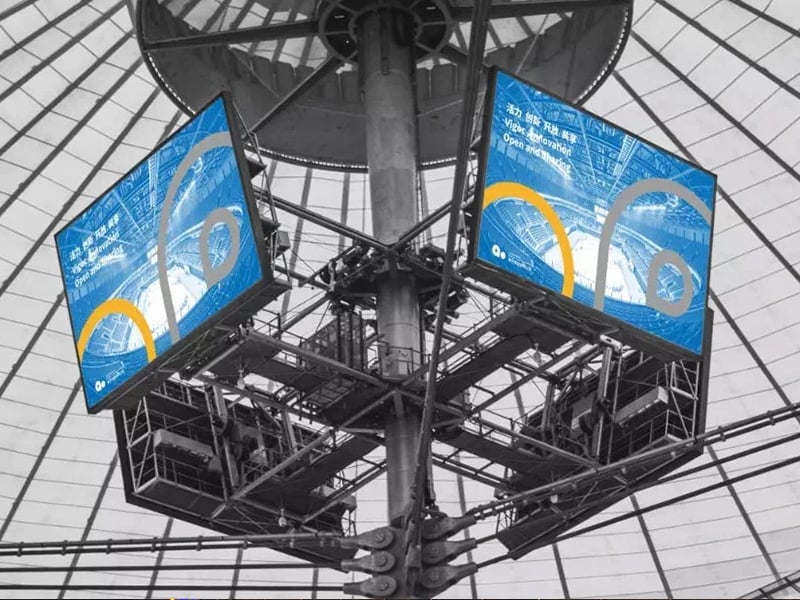
Before choosing an installation position, it helps to understand a basic principle of airflow:
Cold air sinks, while hot air rises.
Because of this natural airflow pattern, installing an air conditioner at the bottom of the LED screen is usually not the most effective solution.
Instead, technicians should install cooling units near the top of the display.
For large LED billboards that require multiple air conditioning units, the ideal approach is to place them in the upper and middle sections of the structure.
This arrangement creates a more efficient cooling cycle:
As a result, the entire display benefits from more balanced temperature control and improved cooling efficiency.
Many LED display buyers focus heavily on specifications such as brightness, pixel pitch, and refresh rate. While these factors are important, long-term reliability often depends on something much simpler: temperature control.
Even an all-aluminum outdoor LED display can suffer from overheating if airflow remains restricted.
By combining high-quality aluminum cabinets with properly designed cooling systems, operators can:
All-aluminum LED displays offer excellent heat conduction and many structural advantages. However, aluminum alone cannot solve every thermal challenge.
Installation conditions, airflow design, and active cooling solutions remain critical factors in outdoor LED display performance. Whether you operate a wall-mounted screen, a pillar display, or a large digital billboard, proper heat management will help protect image quality, extend equipment lifespan, and deliver a stronger return on investment for years to come.
 EN
EN
 AR
AR
 BG
BG
 HR
HR
 CS
CS
 DA
DA
 NL
NL
 FI
FI
 FR
FR
 DE
DE
 EL
EL
 HI
HI
 IT
IT
 JA
JA
 KO
KO
 NO
NO
 PL
PL
 PT
PT
 RO
RO
 RU
RU
 ES
ES
 SV
SV
 TL
TL
 ID
ID
 SR
SR
 UK
UK
 VI
VI
 ET
ET
 HU
HU
 TH
TH
 TR
TR
 FA
FA
 AF
AF
 MS
MS
 GA
GA
 HY
HY
 AZ
AZ
 MN
MN
 UZ
UZ